You may have read my take on a high fantasy novelist writing middle-quality romance. This, friends and fellow readers, is the sequel and conclusion to that story.
Terisa Morgan, a young woman transplanted from her "real" world into the fantasy kingdom of Mordant, has just watched her only friend, the bumbling nobleman Geraden, escape into a mirror after being framed for murder. This escape, though miraculous, leaves Terisa defenseless against a castle full of people who believe that she aided the criminal's flight. Tensions are high, because two marauding armies are racing to that same castle, knowing that whichever takes it first will hold the position to conquer all of Mordant. Meanwhile, old King Joyse refuses to raise a hand in defense of his kingdom. It is up to Terisa alone to escape from her desperate captors and reunite with Geraden, who is her only hope of discovering how an alliance of rogue Imagers (wizards who can pull anything imaginable out of mirrors) are able to translate alien horrors anywhere they please, and whose sinister influence is behind the war that stands at Mordant's door.
I was underwhelmed with the first book; it's not nearly as awe-inspiring as Thomas Covenant, it's too complicated to be a page-turner, and it's not bad enough to be funny. This trend continues into A Man Rides Through. Many, many plots are going on at the same time; after all, Donaldson wrote these two right after the sixth Thomas Covenant, when he was at his peak in terms of subplots. The man is a hydra in that for every subplot he resolves, he creates two more. And he never leaves a thread hanging. This sounds fascinating but is really so only if the story is worth the commitment, and in the Mordant's Need plot, you need a special interest in the characters or the mirror fantasy to feel so involved. Alone, the drama does not justify itself.
Then something incredible happens. About halfway through the book, all the plots take a turn and begin to converge again. The result is like listening to a middle-grade concerto which suddenly reveals that all its disparate melodies, when played at the same time, form a cohesive harmony. It's a load of ordinary devices that fit together with uncanny precision. For a few hundred pages near the end, it's a nonstop hurly-burly of characters picking up Chekhov's guns, only to discover that their targets were wearing Chekhov's bullet-proof vests, but in turn those characters had paid for their vests by borrowing money from Chekhov's loan sharks... It goes on. Every previous action of named character is somehow justified until the plot collapses down to the climax which is a singular event.
To me this instantly makes a fantasy book worth it, but obviously there's more to a novel than structure. Terisa becomes less annoying than in the previous book, but in doing so she loses the better part of her individuality as a character. It frustrates me because Donaldson can write women brilliantly, but Terisa's function is to be a bit shallow. If ever I were to name a problem with this author, it would be his ability to intentionally fall short of his stylistic potential in order to achieve that unerring symbolic consistency.
Overall, the story is entertaining. I enjoyed the various experimentation with monsters created out of mirrors. They're a silly compromise between something grounded in the laws of reality and something from a carnival nightmare. As usual, it takes a stretch to suspend belief of some of the physics, because the magic is symbolic in function. But to me this is refreshing when done right, rather than as a lack of better imagination.
Showing posts with label Stephen R. Donaldson. Show all posts
Showing posts with label Stephen R. Donaldson. Show all posts
Tuesday, August 13, 2013

Thursday, June 6, 2013
Review: Against All Things Ending by Stephen R. Donaldson (2010)
I've already written a little bit about the Thomas Covenant series, of which this is number nine out of ten. Consider it bias, or don't, but just assume that this review will be somewhat more positive than the mark.
Against All Things Ending picks up where Fatal Revenant left off: Linden Avery has just linked the magic of three powerful artifacts to summon the soul of Thomas Covenant from the Arch of Time, back to a human body. But in reviving her lover and the Land's savior, Linden has activated two unforeseen consequences. First, in becoming incarnate once again, Covenant goes nearly mad shedding millennia of personality and experiences because they don't fit into a human mind; he's back to being a deranged leper. And the combination of wild magic and Law to reach past the boundaries of death and time has shifted the balance of the earth and awakened the Worm of the World's End, an unstoppable monster that will now consume the earth in only a few days. Even Covenant himself, were he in full possession of his mind and his complete power, could never out-muscle the Worm. Faced with apocalypse, Linden leads her companions in search of her possessed son, whose talent for inter-dimensional contraptions could be the only way to trap the Worm and save the world. But her trip, effected by costly bargains with many magical beings, brings her within reach of She Who Must Not Be Named, a slumbering titan as old as Lord Foul (the main antagonist) himself, who embodies all the fear, grief and rage of a world betrayed...
For those of you who even read that paragraph, you probably figured out to start with the first book. Hell, this is my favorite series, and I struggled to figure out what was going on.
But guess what: it was worth it.
No, this wasn't the best Thomas Covenant book for me. It has neither the cohesion of Lord Foul's Bane nor the climax of White Gold Wielder. And somehow it manages to be more melodramatic than either, without the payoff. Consider this: the book is about apocalypse, but it's not the last in the series. I'm not spoiling anything by telling you that the Land is still intact at the very end of the book.
This is more than can be said for most of the characters. Donaldson has never squeamish about killing his main cast (which he's done to Covenant twice now), but this book takes it a step higher. The real tension of the book, much greater than the threat of armageddon, is the fact that the book begins with a lineup of characters whose abilities and stories make each of them crucial to the defense of the Land... but one by one they die horribly. It's like a cosmic game of Jenga, which, now that I think of it, is a great way to describe Lord Foul's plans to someone unfamiliar with the series.
Donaldson never drops a storyline without finishing it, and it's incredible to see the way he continues to weave the threads together, even while creating new ones. For certain, the real reason for all the deaths is probably to untangle the knot a little bit. He also picks up dozens of Chekhov's guns, including some he dropped a full eight books ago. If you give it the time and space in your brain, it's a dazzling act of juggling, but it gets confusing if you're distracted for even a page.
One feature that gave me mixed feelings is that by now everyone has superpowers. It was nice back in Lord Foul's Bane when everybody knew a little bit about Earthpower, and Covenant's wild magic was still locked away. Now, aside from Lord Foul, there are three villains (Joan, Kastenessen, She Who Must Not Be Named) trying to tear apart the world with their bare hands, even if you don't count the Worm, which seems to be succeeding. The Insequent are wizards who can teleport, travel through time, and defeat armies singlehandedly. Linden has even more firepower than these, and can heal any wound. Roger Covenant can shoot lava from his hand, and he seems to find armies to serve him the way you or I would order pizza. The Elohim all have powers like Watchmen's Dr. Manhattan, and Esmer has all their magic plus the ability to negate Thomas Covenant.
It becomes a little overwhelming.
This is why to me, the only two pervading important trends are Covenant's mental lapses and Linden's encounter with She Who Must Not Be Named. I think that's what Donaldson was going for with She Who Must Not Be Named: a character he could definitively say was top dog (except for Covenant, Lord Foul, the Worm, Horrim Carabal... never mind) in order to get our minds off of searching for a deus ex machina already hidden in everybody's Superman complexes. Sure, it's not quite as good as her fear of death in the Second Chronicles, but part two of anything is rarely as exciting. As for Covenant, anything but a relapse of leprosy would have thrown away his credibility as our grouchy protagonist.
This may be a wasted post, because those of you who read eight Covenant books were going to read the ninth, or you weren't. But this is a story which, I firmly believe, receives too little attention, so go ahead and introduce or re-introduce yourself to the darkest dream you'd ever give your life to save.
Against All Things Ending picks up where Fatal Revenant left off: Linden Avery has just linked the magic of three powerful artifacts to summon the soul of Thomas Covenant from the Arch of Time, back to a human body. But in reviving her lover and the Land's savior, Linden has activated two unforeseen consequences. First, in becoming incarnate once again, Covenant goes nearly mad shedding millennia of personality and experiences because they don't fit into a human mind; he's back to being a deranged leper. And the combination of wild magic and Law to reach past the boundaries of death and time has shifted the balance of the earth and awakened the Worm of the World's End, an unstoppable monster that will now consume the earth in only a few days. Even Covenant himself, were he in full possession of his mind and his complete power, could never out-muscle the Worm. Faced with apocalypse, Linden leads her companions in search of her possessed son, whose talent for inter-dimensional contraptions could be the only way to trap the Worm and save the world. But her trip, effected by costly bargains with many magical beings, brings her within reach of She Who Must Not Be Named, a slumbering titan as old as Lord Foul (the main antagonist) himself, who embodies all the fear, grief and rage of a world betrayed...
For those of you who even read that paragraph, you probably figured out to start with the first book. Hell, this is my favorite series, and I struggled to figure out what was going on.
But guess what: it was worth it.
No, this wasn't the best Thomas Covenant book for me. It has neither the cohesion of Lord Foul's Bane nor the climax of White Gold Wielder. And somehow it manages to be more melodramatic than either, without the payoff. Consider this: the book is about apocalypse, but it's not the last in the series. I'm not spoiling anything by telling you that the Land is still intact at the very end of the book.
This is more than can be said for most of the characters. Donaldson has never squeamish about killing his main cast (which he's done to Covenant twice now), but this book takes it a step higher. The real tension of the book, much greater than the threat of armageddon, is the fact that the book begins with a lineup of characters whose abilities and stories make each of them crucial to the defense of the Land... but one by one they die horribly. It's like a cosmic game of Jenga, which, now that I think of it, is a great way to describe Lord Foul's plans to someone unfamiliar with the series.
Donaldson never drops a storyline without finishing it, and it's incredible to see the way he continues to weave the threads together, even while creating new ones. For certain, the real reason for all the deaths is probably to untangle the knot a little bit. He also picks up dozens of Chekhov's guns, including some he dropped a full eight books ago. If you give it the time and space in your brain, it's a dazzling act of juggling, but it gets confusing if you're distracted for even a page.
One feature that gave me mixed feelings is that by now everyone has superpowers. It was nice back in Lord Foul's Bane when everybody knew a little bit about Earthpower, and Covenant's wild magic was still locked away. Now, aside from Lord Foul, there are three villains (Joan, Kastenessen, She Who Must Not Be Named) trying to tear apart the world with their bare hands, even if you don't count the Worm, which seems to be succeeding. The Insequent are wizards who can teleport, travel through time, and defeat armies singlehandedly. Linden has even more firepower than these, and can heal any wound. Roger Covenant can shoot lava from his hand, and he seems to find armies to serve him the way you or I would order pizza. The Elohim all have powers like Watchmen's Dr. Manhattan, and Esmer has all their magic plus the ability to negate Thomas Covenant.
It becomes a little overwhelming.
This is why to me, the only two pervading important trends are Covenant's mental lapses and Linden's encounter with She Who Must Not Be Named. I think that's what Donaldson was going for with She Who Must Not Be Named: a character he could definitively say was top dog (except for Covenant, Lord Foul, the Worm, Horrim Carabal... never mind) in order to get our minds off of searching for a deus ex machina already hidden in everybody's Superman complexes. Sure, it's not quite as good as her fear of death in the Second Chronicles, but part two of anything is rarely as exciting. As for Covenant, anything but a relapse of leprosy would have thrown away his credibility as our grouchy protagonist.
This may be a wasted post, because those of you who read eight Covenant books were going to read the ninth, or you weren't. But this is a story which, I firmly believe, receives too little attention, so go ahead and introduce or re-introduce yourself to the darkest dream you'd ever give your life to save.
Sunday, January 6, 2013
Review: The Mirror of Her Dreams by Stephen R. Donaldson (1986)
Close your eyes. Imagine that The Lord of the Rings is your favorite book. You've read it more times than you can count, and you remember more about Middle Earth than you could recite in a day. (For some, this isn't such a stretch.) Now imagine you've found another series by Tolkien, read by few, that takes place not in Middle Earth, but in an entirely new fantasy world. Ravenous for this new discovery, you pick it up and begin to read.
It's a romance novel. Not only that, but it's a mediocre romance novel.
Ladies and gentlemen, this is the fantasy, mystery, bodice-ripper offered to the world by one of my biggest fantasy influences. It was one of my most bizarre experiences of 2012.
Terisa Morgan is a woman who almost literally has no life. She's quiet, submissive, and friendless. She lives alone in an apartment paid for by her rich, aloof father, and spends all day working for a soup kitchen without forming any bonds with the poor she serves. Her biggest fear is disappearing entirely without anyone noticing. This all changes one night when a strange man bursts through her bedroom mirror. His name is Geraden, and he comes from a land in which mirrors can create anything imaginable. Geraden is on a mission to retrieve someone to save his kingdom from destruction, and he believes Terisa to be that champion. With no reason to stay in the life she knows, Terisa follows Geraden into a fantasy world full of familial plots and political games. Amidst a background of danger and wits, Terisa must choose between the affections of Geraden, and a master Imager named Eremis, who is always one step ahead of the plots threatening the land of Mordant.
Donaldson thrives in a setting where ordinary-world people interact with archaic-speaking people who are differently complex: who have an eye for patterns and schemes but who are blind to different subtleties than we are. For example, many of his characters seem to perceive familial ties as something tangible, which makes them stronger than you or I, but we might be quicker to see how relationships might shift, and catch onto deceit more quickly. Even when a Donaldson fantasy character is skeptical, it's in a solid, direct way. This interaction between cemented values and our own subtle shades of gray is what powers the Thomas Covenant series, and it's what saves The Mirror of Her Dreams, but not by a long shot.
You'd think, perhaps as a joke, that your favorite author could pull off a silly romance. After all, the best writers usually know how to shift genres with some skill. The problem is that this is still a fantasy, and Donaldson's fantasy, as opposed to his other work, is usually highly methodical. He ratchets up the tension by revealing one thrilling detail at a time, getting quite a bit of mileage out of each aspect of the plot. This works wonders in Thomas Covenant. But in this novel, where half the details are repetitive flirtations, it gets boring quickly.
There's a fair amount of philosophic value diluted amid the sappiness. Although Terisa's fear of disappearing makes a bad metaphor, it creates some interesting avenues for existential questioning. A good amount of space is devoted to the question of whether Terisa existed prior to appearing in Mordant. Even she is unable to resolve them. The philosophy is relatively outdated, but it's still solid.
If you're a connoisseur of romance novels, try this one on for size. If not, don't make this your introduction to Donaldson. I plan to read the concluding sequel, A Man Rides Through, which I hope will be an improvement.
It's a romance novel. Not only that, but it's a mediocre romance novel.
Ladies and gentlemen, this is the fantasy, mystery, bodice-ripper offered to the world by one of my biggest fantasy influences. It was one of my most bizarre experiences of 2012.
Terisa Morgan is a woman who almost literally has no life. She's quiet, submissive, and friendless. She lives alone in an apartment paid for by her rich, aloof father, and spends all day working for a soup kitchen without forming any bonds with the poor she serves. Her biggest fear is disappearing entirely without anyone noticing. This all changes one night when a strange man bursts through her bedroom mirror. His name is Geraden, and he comes from a land in which mirrors can create anything imaginable. Geraden is on a mission to retrieve someone to save his kingdom from destruction, and he believes Terisa to be that champion. With no reason to stay in the life she knows, Terisa follows Geraden into a fantasy world full of familial plots and political games. Amidst a background of danger and wits, Terisa must choose between the affections of Geraden, and a master Imager named Eremis, who is always one step ahead of the plots threatening the land of Mordant.
Donaldson thrives in a setting where ordinary-world people interact with archaic-speaking people who are differently complex: who have an eye for patterns and schemes but who are blind to different subtleties than we are. For example, many of his characters seem to perceive familial ties as something tangible, which makes them stronger than you or I, but we might be quicker to see how relationships might shift, and catch onto deceit more quickly. Even when a Donaldson fantasy character is skeptical, it's in a solid, direct way. This interaction between cemented values and our own subtle shades of gray is what powers the Thomas Covenant series, and it's what saves The Mirror of Her Dreams, but not by a long shot.
You'd think, perhaps as a joke, that your favorite author could pull off a silly romance. After all, the best writers usually know how to shift genres with some skill. The problem is that this is still a fantasy, and Donaldson's fantasy, as opposed to his other work, is usually highly methodical. He ratchets up the tension by revealing one thrilling detail at a time, getting quite a bit of mileage out of each aspect of the plot. This works wonders in Thomas Covenant. But in this novel, where half the details are repetitive flirtations, it gets boring quickly.
There's a fair amount of philosophic value diluted amid the sappiness. Although Terisa's fear of disappearing makes a bad metaphor, it creates some interesting avenues for existential questioning. A good amount of space is devoted to the question of whether Terisa existed prior to appearing in Mordant. Even she is unable to resolve them. The philosophy is relatively outdated, but it's still solid.
If you're a connoisseur of romance novels, try this one on for size. If not, don't make this your introduction to Donaldson. I plan to read the concluding sequel, A Man Rides Through, which I hope will be an improvement.
Tuesday, June 26, 2012
My Two Big Fantasy Influences, Part 2
Stephen R. Donaldson
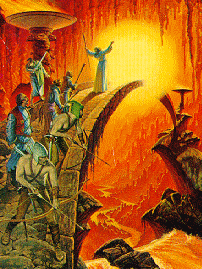 Hey, look! It's an author of what ordinary people would call fantasy! Stephen R. Donaldson is most famous for his series The Chronicles of Thomas Covenant the Unbeliever, The Gap Cycle, and Mordant's Need. Of these, I've read only Thomas Covenant, but those books are inextricably at the top of my list of favorites.
Thomas Covenant is a leper who has lost everything and lives as an outcast in a midwestern American town. One day, he blacks out and wakes up in the Land, a world where beauty and health are tangible forces, like color or gravity. Covenant believes he is losing his mind, and although his experience is detailed and convincing, he tries to remain certain that he is trapped in an elaborate dream. But to the inhabitants of the Land, Covenant is the only living person who can defeat their immortal enemy, the Despiser. Covenant therefore must find a way to save these people without admitting they are real.
The first and best part of Donaldon's writing is his ability to think of scenarios like that. Instead of putting his characters in trouble by having them captured by brigands or chased by wolves (although his stories contain elements of these), he writes them into psychological obstacle courses. His short stories, as I've discussed, take these issues in hand, but Covenant is what really makes a masterpiece of it. Donaldson's short story "Gilden-Fire," originally part of book 2 of Covenant, was actually removed from that book because it accidentally implied a resolution to the question of the land's reality. His "real world" characters: Covenant, Troy, Linden, Joan, and Roger, are never let off the tightrope between accepting or rejecting the dream.

The criticism I read most often about Donaldson is about his verbosity. There are websites devoted to the archaic words that only he still uses. This kind of problem goes two ways. If you're not in love with the books, then the vocabulary is probably going to push you further away, because you won't be motivated to look up the word if it's not clear from the context. I strongly prefer it, and find it highly poetic. The problem is that I can't (and shouldn't) replicate it perfectly in my own writing, nor are my books the appropriate setting for that kind of language, so it's a challenge to emulate without copying.
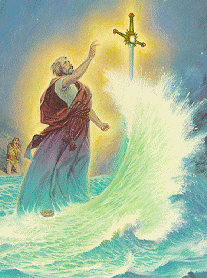 Donaldson is able to get away with this style in Covenant and not quite in his short stories because of the concrete elements that make up the Land. What some science fiction writers and even a few of fantasy get wrong is the complexity of symbolism. Symbols tend to become less real as they become complicated, unless they're a direct analogy, like parodies or political satire. Dragons, for instance, can mean nearly anything unless they're hammered down in a certain style; Tolkien, for instance, gives Smaug the dragon the direct speech patterns of an upper-class Englishman of old money, so that his message is clear enough. But real symbols are much more than a one-to-one substitution that fits the text, and high school English classes aren't likely to admit this.
Take stone, for example. Stone in Covenant has substantial qualities than actual stone does. Giants can sing to stone and make it move or float, and some stones can harness the energy of the sun in order to perform ritual magic. This doesn't mean that Donaldson means stone to be a metaphor for jet fuel or something more powerful found here on Earth. Stone, in essence, is just a metaphor for itself. To respect the power of stone as part of the story is to notice a basic underlying pattern in the elements of our own world. This, too, is fantasy.
Thomas Covenant fans are sometimes described, even self-described, as hopeless masochists, because of the incredibly depressing course each of the characters follows. It's no mere thrill ride, however. Characters do not turn up dead for no reason, nor is Covenant battered with misery just to evoke an emotional response from the reader. If you are looking for a sob story, Covenant is not your man, largely because he's not very likable. Instead, the books are a great example of the wise advice of the late Kurt Vonnegut, Jr.: "No matter how sweet and innocent your leading characters, make awful things happen to them–in order that the reader may see what they are made of." Thomas Covenant is neither sweet nor innocent, but through reading them and then looking around, I've seen what I'm made of, what people are made of, and what the world is made of. I can give a book no higher praise.

Does this sound familiar? Probably.
The criticism I read most often about Donaldson is about his verbosity. There are websites devoted to the archaic words that only he still uses. This kind of problem goes two ways. If you're not in love with the books, then the vocabulary is probably going to push you further away, because you won't be motivated to look up the word if it's not clear from the context. I strongly prefer it, and find it highly poetic. The problem is that I can't (and shouldn't) replicate it perfectly in my own writing, nor are my books the appropriate setting for that kind of language, so it's a challenge to emulate without copying.
Donaldson is able to get away with this style in Covenant and not quite in his short stories because of the concrete elements that make up the Land. What some science fiction writers and even a few of fantasy get wrong is the complexity of symbolism. Symbols tend to become less real as they become complicated, unless they're a direct analogy, like parodies or political satire. Dragons, for instance, can mean nearly anything unless they're hammered down in a certain style; Tolkien, for instance, gives Smaug the dragon the direct speech patterns of an upper-class Englishman of old money, so that his message is clear enough. But real symbols are much more than a one-to-one substitution that fits the text, and high school English classes aren't likely to admit this.Take stone, for example. Stone in Covenant has substantial qualities than actual stone does. Giants can sing to stone and make it move or float, and some stones can harness the energy of the sun in order to perform ritual magic. This doesn't mean that Donaldson means stone to be a metaphor for jet fuel or something more powerful found here on Earth. Stone, in essence, is just a metaphor for itself. To respect the power of stone as part of the story is to notice a basic underlying pattern in the elements of our own world. This, too, is fantasy.
Thomas Covenant fans are sometimes described, even self-described, as hopeless masochists, because of the incredibly depressing course each of the characters follows. It's no mere thrill ride, however. Characters do not turn up dead for no reason, nor is Covenant battered with misery just to evoke an emotional response from the reader. If you are looking for a sob story, Covenant is not your man, largely because he's not very likable. Instead, the books are a great example of the wise advice of the late Kurt Vonnegut, Jr.: "No matter how sweet and innocent your leading characters, make awful things happen to them–in order that the reader may see what they are made of." Thomas Covenant is neither sweet nor innocent, but through reading them and then looking around, I've seen what I'm made of, what people are made of, and what the world is made of. I can give a book no higher praise.
Saturday, May 26, 2012
Review: Daughter of Regals & Other Tales by Stephen R. Donaldson (1984)
This will be the first in what will probably become the most common feature of this blog: my opinion of anything and everything I happen to read. I must first point out that my very favorite fantasy series, The Chronicles of Thomas Covenant the Unbeliever, are written by this same Stephen R. Donaldson. Although my opinion of Daughter of Regals stands on its own, the context can’t be ignored.
All this is a way to say that Daughter of Regals didn’t thrill me.
The book is a collection of eight short stories, and so my opinion of it must be more complicated than “aye” or “nay.” The first two were actually quite good. “Daughter of Regals” is a political fantasy that’s both exciting and as intricate as a same-sized chunk of any of the Covenant books, meaning that every single detail is ultimately relevant to the story’s outcome. Other than a couple of ridiculous characters, it kept me interested for the whole ride. I couldn’t find any significant moral depth, but it was a good story.
“Gilden-Fire,” the second piece in the book, is an excerpt from The Illearth War, one of the Covenant books. Needless to say, it hooked me, but I can’t imagine approaching it without having read the First Chronicles. So I wouldn’t recommend it.
And the rest of the pieces were uninspired by comparison. To get an idea, they are as follows:
-"Mythological Beast" is set in a dystopian future where everyone has a job but nobody does any work. Every person is equipped with a "biomitter," a device built into the wrist that reads "You are OK" as long as he or she is "healthy." If you fall ill, the biomitter calls the hospital workers, who come and take you away. This doesn't work out very well when our main character begins to transform into a unicorn.
-"The Lady in White" is about an enchantress who captures, one by one, the men of a small village. This story's narrative style was uniquely obnoxious and difficult to read. I'll call it the worst of the set.
-"Animal Lover" is a pretty neat sci-fi story that involves cyborgs and genetic engineering. My favorite part is the fact that it's set in... well: "Here we were in the year 2011–men had walked on Mars, microwave stations were being built to transmit solar power, marijuana and car racing were so important they were subsidized by the government." All this is narrated by a gritty government agent with a laser cannon in his hand. I've been waiting for the day I could compare the present day to a sci-fi prediction (other than Nineteen Eighty-Four). In all honesty, the story succeeds in spite of this disconnection, making it one of my favorites. It's careful, complex, and energetic.
-"Unworthy of the Angel" has a story that didn't make a whole lot of sense to me. Donaldson, most of whose writing is rather atheistic, is attempting what he calls "religious fantasy," and it's apparent that he's outside of his comfort zone. However, he gets a lot of things right about the characterization of a guardian angel, and he hits many of the important points about the relationship between an artist and his work. I think the fantasy failed here but the philosophy held the story intact.
-"The Conqueror Worm" is a strange little horror story about what happens to a failing marriage when a large centipede attacks. I don't think I have to say any more.
-"Ser Visal's Tale" is about a fellow who becomes mixed up in the troubles of a witch who is abused by "The Temple." I tend to hate these kinds of stories for their obviousness and their attempts to be relevant and political. Of course we sympathize with the witch, because none of the other characters, especially the Templemen, are at all realistic as people. I'm also a little sour because the back cover told me this one "ends with a surprising twist." Surprise: it doesn't.
-"Animal Lover" is a pretty neat sci-fi story that involves cyborgs and genetic engineering. My favorite part is the fact that it's set in... well: "Here we were in the year 2011–men had walked on Mars, microwave stations were being built to transmit solar power, marijuana and car racing were so important they were subsidized by the government." All this is narrated by a gritty government agent with a laser cannon in his hand. I've been waiting for the day I could compare the present day to a sci-fi prediction (other than Nineteen Eighty-Four). In all honesty, the story succeeds in spite of this disconnection, making it one of my favorites. It's careful, complex, and energetic.
-"Unworthy of the Angel" has a story that didn't make a whole lot of sense to me. Donaldson, most of whose writing is rather atheistic, is attempting what he calls "religious fantasy," and it's apparent that he's outside of his comfort zone. However, he gets a lot of things right about the characterization of a guardian angel, and he hits many of the important points about the relationship between an artist and his work. I think the fantasy failed here but the philosophy held the story intact.
-"The Conqueror Worm" is a strange little horror story about what happens to a failing marriage when a large centipede attacks. I don't think I have to say any more.
-"Ser Visal's Tale" is about a fellow who becomes mixed up in the troubles of a witch who is abused by "The Temple." I tend to hate these kinds of stories for their obviousness and their attempts to be relevant and political. Of course we sympathize with the witch, because none of the other characters, especially the Templemen, are at all realistic as people. I'm also a little sour because the back cover told me this one "ends with a surprising twist." Surprise: it doesn't.
I suppose my lesson from this book is that mediocre fantasy is all over the place, and even the best writers can fall into it. A story, no matter what the genre, is made up of something to be said and a way of saying it. If these elements aren’t synchronized, the results are messy. If they are, then it’s a success. Genre isn’t something to be transcended; it’s always a means of reaching something that can’t be reached any other way.
Looking over my thoughts about this book, I've realized that it reflects, in a way, what I plan to do with this blog. It's a collection of short stories, not necessarily the author's best, all in one volume. The diversity makes it enjoyable, but there's also the reminder that even the cleverest writer has bad days. Years of constant practice are necessary just to produce one great book. When that happens, it shouldn't kill the writing spirit–as Donaldson explores early in Thomas Covenant's experience with leprosy–but it should be the peak in a process that is contained not only in the surviving text, but along the river of the author's life.
Looking over my thoughts about this book, I've realized that it reflects, in a way, what I plan to do with this blog. It's a collection of short stories, not necessarily the author's best, all in one volume. The diversity makes it enjoyable, but there's also the reminder that even the cleverest writer has bad days. Years of constant practice are necessary just to produce one great book. When that happens, it shouldn't kill the writing spirit–as Donaldson explores early in Thomas Covenant's experience with leprosy–but it should be the peak in a process that is contained not only in the surviving text, but along the river of the author's life.
Subscribe to:
Posts (Atom)